Archive for category 3D

Macworld: Mudbox 2009 is Coming to the Mac!

macproducts_800x_autodeskWhile Pixologic was busy pissing off its customers today, Autodesk has been sneaking up on them.

The big news for sculptors at Macworld:  Autodesk Mudbox 2009 is coming to the Mac!   No details yet, but published in Architosh:  ”While some products were previously announced for the Mac today Autodesk is unveiling Mac OS X support for Autodesk Mudbox 2009, Autodesk Toxik 2009, and Autodesk ImageModeler 2009 for the first time.”

http://architosh.com/2009/01/mwsf-a…w-mac-products/

You can bet that I’ll be shelling out the dough for Mudbox when available and will try to get a Mac first-look here as shortly thereafter.

Now things get interesting!

—————–
Update:

From the press release.  Expected ETA is February this year.

Autodesk Mudbox 2009: A highly intuitive application for painting, texturing and re-touching 3D models. Mudbox software gives 3D modelers, artists and designers the freedom to create without worrying about the technical details. Breaking the mold of traditional 3D modeling applications, Mudbox 2009 provides an organic brush-based 3D modeling and texture painting experience that ignites the creative process. Mudbox 2009 for Mac OS X is expected to be available in English in February 2009. Autodesk suggested retail pricing for Mudbox 2009 is expected to be $745 USD*.”

http://pressreleases.autodesk.com/index.php?s=press_releases&item=514%3C%2Ftd%3E

Tags: ,

What is a Show Stopper?

Apparently the folks at Pixologic don’t get it.   The inability to construct mac-based displacement maps without artifacts is apparently not a “Show stopper” to them.  I was struck by this original concept–the maker of a product, deciding for themselves what is a “show stopper.”   What next?  Cars without brakes?  It’s not a show stopper, just use your feet . . .

It is this kind of nonsense from a manufacturer that engenders the love-hate relationship between Pixologic and it Mac user base.  On the one hand, they build a unique and interesting product.  They promise a mac version for years and when they ultimately deliver, it’s broken in several places.  They promise to fix it in the next version and promise it will be delivered last year.   Then, when called on it they sheepishly announce “we’ll tell you later.”   When further called on it, they derride the concern as not a show stopper.   This is a PR nightmare and it amazes me to watch a company just dig themselves in deeper.   If you think it is a showstopper, let Pixologic know: support@pixologic.com.

References
——————–
http://zbrushcentral.com/zbc/showthread.php?t=61998 
http://www.zbrushcentral.com/zbc/showpost.php?p=517238&postcount=14
http://www.zbrushcentral.com/zbc/showthread.php?t=64630&page=7&pp=15

Tags:

Zbrush Mechanical Part 5, Quick Alpha From Geometry

Zbrush makes it easy to quickly create an alpha from geometry, which in turn can be used to detail objects.   Let’s take the hex nut from the previous exercise.   By turning SMT on in the Geometry Subpallet art level 4 and subdividing a bit more I’ve rounded the edges to give me a nice bevel.   I just position it so I’m looking straight down on it, (use shift-drag outside the object to snap the view to the nearest orthogonal position.)  To make an Alpha from this shape, it’s just as easy as going to alpha pallet and clicking “GrabDoc”.   A new alpha is available on your alpha pallet, starting “ZGRAB” like magic!original-nut

You’re not quite done yet–ZB prefers square alphas to avoid distortion and because I was lazy, the canvas was actually 800 x 600.   It’s a quick fix in an image editor, so export the alpha from the image pallet, fire up photoshop and crop to 512×512.photoshopcrop

Name the file it something suitable, reload it into ZB, and now you sculpt with it using any brush you like (I prefer the Clay or Layer brushes for example.)  

hexhead

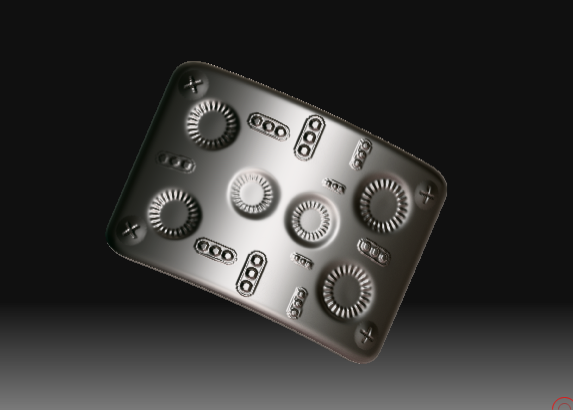
Turn on symmetry and with one stroke, I have detailing on a plate.sculpted-alpha

Tags: ,

Zbrush Mechanical Device Example

Here’s an example of using basic Zbrush building blocks.   I’ve not added much detail yet, but it gives you an idea of the power of ZB’s Primitives.   100% modeled and rendered in ZB 3.12 Mac.kfootsamp

Tags:

Zbrush Mechanical Part 4, Rounded Holes

I needed a hexagonal part with a round hole in the middle.   This would seem to be a challenge for ZBrush requiring an outside modeler.   However, it is actually pretty easy in ZB if you know primitives and deformers.

First, we can start with our old friend the cylinder primitive:cyl1   

Not very hexagonal yet, and too long, but we can fix that.  We tweak the number of sides to 6 and shorten the z-length in the “initialize” menu:hex2

Better, but no hole . . . We can solve that by setting the “inner radius”:hexhole3

Nuts, close, but the inside whole isn’t round.   I’ll need to fix that up before the boss sees it.   I go ahead and make this a poly mesh and then group the inside polygons.  I also divide the polymesh a few times (well, 3 actually) with the “SMT” option off (so that it doesn’t round off my hexagonal prism).  Showing just the inside polygons (with display-double on for ease of viewing, I have:

holegroup4

Now if there was a easy way to round those off, I’d be home free.   Hey, what about that “deformations” subpallet?defmenu

Ooo . . . I like that “RFlatten” thing . . . (It’s short for Radial Flatten).   A little RFlatten and slight tweak of the size (with just X & Y turned on) and I have a nice round hole.  roundedhole5

Unhiding my geometry, I’m good to go:finishedhex

Total time to  model: less than two minutes.

Tags: ,