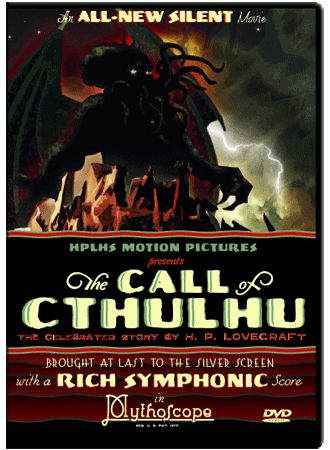
 As most Lovecraft fans know, translating his works to the screen has been difficult and with mixed results at best. Even when his work does get translated to the screen, such as in 1963’s “The Haunted Palace” starring Vincent Price and directed by Roger Corman, it often gets marketed as the much more recognizable E.A. Poe, even when the main source material was Lovecraft’s “The Case of Charles Dexter Ward” (written 1927, published 1941). Well the H.P. Lovecraft Historical Society‘s feature-length adaptation of “Call of Cthulhu” (written 1926) is a great example that Lovecraft can be successfully adapted to film! Lovingly done in the style of a 20’s era silent film, this production is a treat, conjuring the uncanny cosmic horror of the classic tale of Cthulhu rising from the sunken city of R’lyeh.
Archive for January, 2007
Call Of A Good Film
Jan 31
Welcome to Lovecraft Forest!
Jan 14
Welcome to the Lovecraft Forest Blog. Right now, Linden Labs has moved our signup into the pending category, so we expect that our sim will appear in north of Jaguar Valley and south of Pony Island any day now. Harold’s busy on the infrastructure, so expect that we’ll be up and running soon!
